
What Are the Best China Eye Massagers for Import?

What Are the Best China Eye Massagers for Import? The answer depends on more than factory price or attractive packaging. Importers must examine comfort, heat control, battery safety, supplier capability, and destination-market compliance. Grand View Research’s consumer electronics market analysis highlights rising demand for compact wellness devices, while IMARC Group’s massage equipment research points to stronger interest in home-based relaxation products. These findings support the category’s potential, but they do not guarantee commercial success.

China offers broad manufacturing experience in Eye Massagers, from basic vibration models to products combining air pressure, warmth, music, and app controls. A reliable buyer should request factory audit records, material declarations, sample test results, and traceable production information. Check the hinge after repeated folding. Measure actual surface temperature. Listen for compressor noise in a quiet room. Small details often shape customer reviews.

Regulatory expectations also require careful planning. Depending on the destination, importers may need electrical safety, electromagnetic compatibility, battery, labeling, and consumer-product documentation. Relevant frameworks can include IEC standards, the EU CE system, and applicable U.S. requirements. Product classification may vary, so professional compliance advice remains important. A supplier’s certificate is not automatically proof of full market access.

This guide compares practical sourcing factors, not just advertised features. Some popular designs may feel impressive initially but disappoint after frequent charging or poor pressure calibration. That weakness deserves attention. The best choice balances verified quality, realistic pricing, user comfort, and dependable after-sales support.
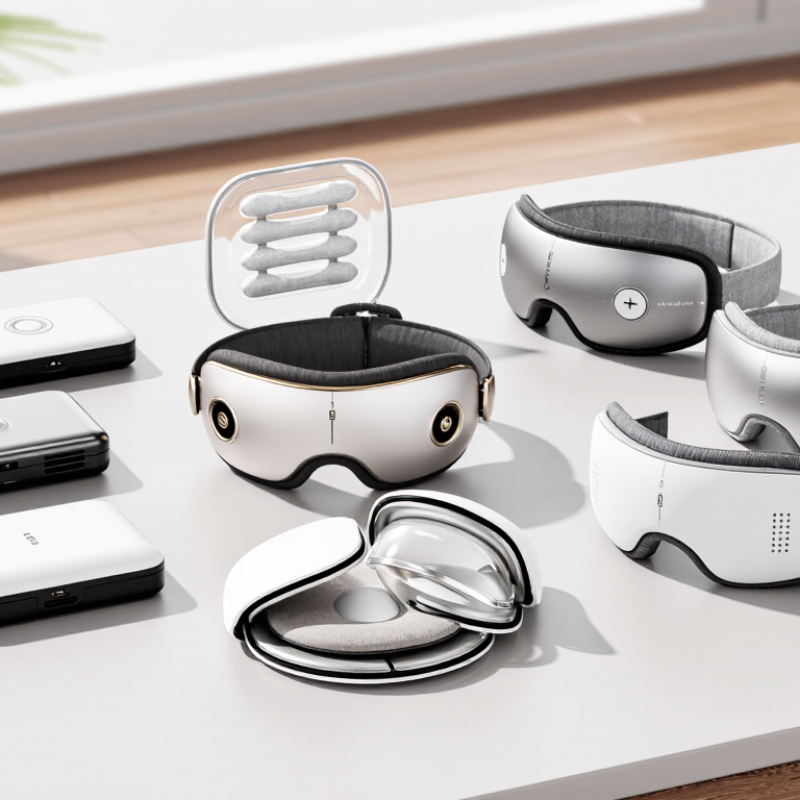
What Are the Best China Eye Massagers for Import?

China Eye Massager Categories and Their Key Features

China eye massagers generally fall into three import categories: air-pressure and heat models, vibration models, and smart multifunction devices. Air-pressure units compress the temples and brow area with inflatable chambers. Heat usually ranges from 38°C to 42°C. Vibration models are lighter, quieter, and easier to pack for retail shelves. Smart devices may combine heat, compression, music, and app controls, but software adds support costs.

The Vision Council’s 2023 Digital Eye Strain report found that 104 million U.S. adults experienced related symptoms. This supports demand for home comfort products, not medical treatment. Importers should inspect pressure levels, heating consistency, noise output, hinge strength, and battery safety. A soft silicone face pad matters. So does easy cleaning. Grand View Research valued the global beauty devices market at approximately US$35.3 billion in 2022, with continued growth expected through 2030. Eye massagers occupy a smaller niche within that market.

Product selection needs practical testing. I would request samples and measure surface temperature after twenty minutes. User manuals should explain suitable use and basic cautions clearly. Some models feel impressive in demonstrations but become uncomfortable after ten minutes. That weakness is easy to miss. Buyers also need stable charging ports, replaceable cushions, and packaging that survives humid warehouses. Bluetooth features may attract attention, yet they can increase returns without improving comfort. WHO’s global vision report also reminds importers that vision impairment affects at least 2.2 billion people, so product claims must remain careful and evidence-based.

How to Assess Product Quality, Safety, and User Comfort

Importers should judge China-made eye massagers through measurable quality, safety, and comfort checks. The Global Wellness Institute reported that the global wellness economy reached $6.3 trillion in 2023. This growth increases demand, but attractive packaging does not prove reliability.

Request batch-level test records, not general certificates. Check heating accuracy, motor noise, air-pressure strength, charging temperature, and battery protection. IEC 62133-2 testing can support rechargeable-battery safety, while EMC, RoHS, and material assessments should match the destination market. The EU Safety Gate 2023 report listed 3,412 product safety alerts, showing why supplier paperwork needs independent verification. Documents can still be incomplete.

Inspect ten or more units from the same production batch. Measure surface temperature across the eye area, especially near the eyelids. The cushion should feel soft, stable, and easy to clean. A strong massage is not automatically better. Excessive pressure, flashing lights, or rigid seams may discourage regular use. Ask testers to wear the device for ten minutes without viewing promotional claims. Their comments often reveal discomfort that specifications miss.

Review instructions for clear warnings, charging guidance, cleaning steps, and user limitations. Avoid suppliers promising to treat disease unless properly authorized for that market. A small weakness matters: a short cable, unclear button labels, or a warm charger can create returns. Import decisions should balance laboratory evidence with real user handling, because neither source is perfect alone.

Comparing Suppliers, Certifications, and Customization Options

What Are the Best China Eye Massagers for Import?

Selecting a China-based eye massager supplier requires more than comparing catalog prices. Importers should inspect factory capacity, quality controls, and experience with export documentation. A video tour helps, but an independent factory audit is stronger evidence. Ask for production photos, batch records, and a sample from regular inventory. Ask for proof.

Certifications must match the destination market and product design. Request current test reports for electrical safety, electromagnetic compatibility, battery transport, and restricted substances. CE, FCC, RoHS, or similar documents may apply, but their relevance depends on the importing country. Check the testing laboratory and report number independently. ISO 9001 supports process control, yet it does not automatically prove product safety. Read every document carefully. A certificate copied from another model is a serious warning.

Customization can include heating temperature, massage modes, strap materials, charging ports, firmware, packaging, and printed manuals. Confirm which changes require new testing. Ask for tolerances, such as heating limits and charging performance, rather than accepting vague promises. For a pilot order, test ten to twenty units across different cartons. Check comfort, noise, hinge strength, battery duration, and charging after repeated use. A polished sample may hide inconsistent assembly. That possibility deserves attention. Low minimum order quantities are useful, but they can increase unit costs and reduce customization depth. Agree on inspection standards, defect handling, spare parts, and delivery terms before paying a deposit. Clear records protect both sides.

What Are the Best China Eye Massagers for Import? - Comparing Suppliers, Certifications, and Customization Options

Supplier Profile Best for Common Product Configuration Typical Customization Scope Indicative MOQ Range Key Certifications and Documents to Request Main Verification Points Customization Difficulty Import Risk Level
OEM/ODM Manufacturer Established brands seeking exclusive functions, packaging, and long-term production Rechargeable eye massager with air compression, vibration, heat, and optional audio Housing color, logo, firmware, massage programs, battery capacity, packaging, user manual, accessories, and mold changes Typically 100–500 units for standard customization; tooling projects may require more CE documentation for applicable EU requirements, RoHS test report, EMC/LVD evidence where applicable, UN38.3 transport test summary, battery MSDS/SDS, and quality-system evidence such as ISO 9001 Confirm that reports identify the actual factory, exact model, battery, adapter, and tested configuration High Medium
Standard-Model Factory Importers requiring proven products with moderate branding and limited technical changes Foldable rechargeable model with heat, vibration, adjustable compression, and USB charging Logo printing, color selection, retail box, language labels, charging cable, and preset program selection Typically 50–300 units, depending on packaging and color requirements Declaration of Conformity where required, EMC test evidence, RoHS report, battery transport documents, product specification sheet, and inspection records Check whether the certificate applies to the final private-label product rather than only to an older or similar model Medium Low to Medium
Trading and Export Supplier Small importers needing product selection, consolidated shipping, and flexible order coordination Multiple ready-made models sourced from different production facilities Usually limited to logo labels, packaging, color, and bundled accessories Often 20–100 units per model, subject to factory approval Request manufacturer-issued test reports, product declarations, battery documents, factory address, production authorization, and batch inspection records Verify the actual manufacturer, model number, document ownership, warranty responsibility, and consistency between sample and shipment Low Medium to High
Private-Label Assembly Partner Online sellers and retailers testing a new product category with a branded presentation Compact eye massager with heat and vibration, supplied with branded packaging Logo, box artwork, inserts, language localization, barcode labels, warranty card, and product bundles Typically 50–200 units for standard components and printed packaging RoHS evidence, applicable EMC documentation, battery test summary, packaging material information, user manual, and traceability records Review labeling, importer details, charging instructions, warnings, language requirements, and packaging accuracy for the destination market Medium Low to Medium
Medical-Device-Oriented Manufacturer Buyers making regulated therapeutic or medical claims in markets with medical-device rules Electrical eye-care device with defined intended use, controlled output, and documented risk management Intended-use statement, software, safety controls, packaging, clinical or performance evidence, and technical documentation Often 100–500 units or more, depending on validation, documentation, and production controls Destination-market medical-device requirements, ISO 13485 where relevant, risk-management records, electrical safety and EMC evidence, clinical or performance substantiation, and post-market procedures Confirm the intended use, classification, responsible legal manufacturer, registration route, technical file, and claim substantiation before advertising Very High High
Smart-Feature Supplier Technology-focused importers wanting Bluetooth, audio, sensors, or app connectivity Eye massager with wireless audio, app functions, rechargeable battery, heat, and air compression Firmware, app language, Bluetooth module, user interface, cloud service, data policy, packaging, and branding Typically 200–1,000 units, depending on software and wireless-module changes Applicable radio approval such as FCC for the United States or RED-related evidence for the European Union, EMC evidence, RoHS, battery documents, privacy policy, and cybersecurity information where applicable Check wireless-module approval, app ownership, data collection, software update support, account security, and continued compatibility High Medium to High
Import checklist: Certification requirements depend on the destination country, product design, power source, wireless functions, and marketing claims. For rechargeable products, request the battery specification, UN38.3 test summary, MSDS/SDS, charger information, and transport classification. Do not use medical or therapeutic claims unless the product and documentation satisfy the applicable rules in the target market.

Import Costs, Minimum Orders, and Shipping Considerations

For importing eye massagers from China, landed cost matters more than the factory price.

A practical quotation should include the device, packaging, spare parts, inspection, export handling, freight, insurance, duties, and local taxes. The World Bank’s 2023 Logistics Performance Index evaluates customs, infrastructure, tracking, and delivery reliability on a 1–5 scale. These factors can change your real margin sharply. Ask suppliers for both EXW and FOB prices. Comparing only unit prices is a common mistake.

Minimum order quantities often range from 100 to 500 units for standard models, while customized molds or packaging may require more. Request a sample before committing. Check heating temperature, battery capacity, charging safety, noise, hinge strength, and skin-contact materials.

A third-party inspection can cost less than correcting a container of faulty products. I have found that packaging revisions are often underestimated. They can add cartons, labor, and several days.

Shipping choice depends on urgency and volume.

UNCTAD’s Review of Maritime Transport reports that shipping carries over 80% of global merchandise trade by volume, making sea freight economical for larger orders. Air freight suits samples but can erase profit on bulky cartons.

Confirm carton dimensions, gross weight, battery documentation, HS classification, and destination charges before payment. Incoterms 2020 should clearly define risk transfer and insurance responsibility.

Numbers move. Leave a contingency budget of roughly 10–15%, because port fees, currency changes, and inspection delays rarely follow the first quotation.

How to Select the Best China Eye Massager for Your Market

Selecting the best China eye massager begins with your market, not the lowest factory quote. A commuter-focused market may prefer compact devices, quiet motors, and USB-C charging. Older users may need larger buttons, softer pressure, and clear operating instructions. I have learned that “comfortable” is not universal. Test samples on different face shapes before approving a design. Ask suppliers for material details, battery data, noise readings, and production experience.

Reliability should be checked through more than attractive product photos. Request sample units from several factories and compare heat, vibration, air pressure, charging time, and cleaning access. Use a written inspection standard for hinges, seams, controls, packaging, and battery performance.

Independent pre-shipment inspection can reveal inconsistent assembly or missing accessories. Do not accept vague safety documents. Confirm applicable electrical, battery, labeling, and import requirements for your destination market. Have qualified local professionals review required documentation.

Commercial fit matters as much as technical quality. Discuss realistic minimum order quantities, replacement parts, lead times, carton strength, and customization fees. A low unit price can become expensive when returns, damaged cartons, or language errors appear. Request packaging samples with translated instructions and accurate warnings. Avoid unsupported promises such as curing eye disease or improving vision. Use measurable comfort descriptions instead. One weakness in my own evaluation was overlooking after-sales training until the first customer questions arrived. Build troubleshooting guides and response procedures before shipment. Then test the final batch under ordinary warehouse and retail conditions.

Go to Top