
China Top Aluminium Door And Frame Manufacturers?

Choosing China’s top Aluminium Door And Frame manufacturers requires more than comparing glossy catalogs or low quotations. A dependable supplier must combine precise extrusion, stable assembly, tested hardware, and responsive technical support. The details matter: 6063-T5 profiles, clean corner joints, PA66 thermal breaks, EPDM seals, and correctly designed drainage paths.

Zhang Wei, a senior aluminium fenestration engineer with more than twenty years of factory experience, observes, “A strong door begins with controlled tolerances, not attractive photographs.” This practical view deserves attention. A frame may look flawless on a showroom wall, yet fail when exposed to coastal humidity, strong sunlight, or repeated opening cycles.

Leading manufacturers usually provide powder-coating records, alloy certificates, thermal-performance data, and evidence of water and air testing. They also explain how profiles are cut, crimped, sealed, packed, and inspected before shipment. Factory visits can reveal important realities, including worn tooling, crowded production lines, or inconsistent quality checks.

Still, no manufacturer is perfect. Even experienced exporters can miss a packaging detail or underestimate installation conditions. Buyers should question promised delivery times, replacement policies, and project references. A serious comparison should consider total service value, not only the lowest unit price.

This guide examines China’s strongest manufacturers through product quality, engineering capability, customization, certifications, production experience, and communication reliability. The ranking may not fit every project. Residential renovations, coastal towers, commercial entrances, and fire-rated applications require different priorities. Careful judgment remains essential.
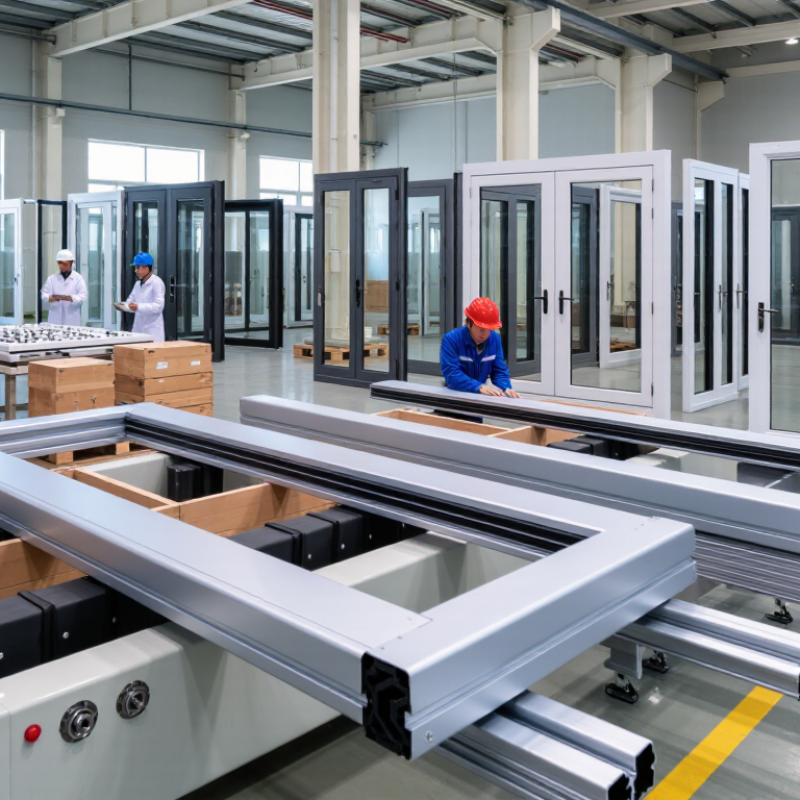
China Top Aluminium Door And Frame Manufacturers?

Aluminium Door and Frame Manufacturing in China

China’s aluminium door and frame manufacturing sector benefits from a deep metal supply chain. The International Aluminium Institute reported that China produced about 41.6 million tonnes of primary aluminium in 2023. This scale supports extrusion, powder coating, machining, glazing, and assembly within one industrial network.

Manufacturing quality depends on more than attractive profiles. A reliable factory controls alloy composition, extrusion tolerances, coating thickness, and corner strength. Practical checks should include a 6063-T5 or 6063-T6 alloy certificate, coating inspection, and sample frame assembly. The American Architectural Manufacturers Association recommends testing air leakage, water penetration, and structural performance for fenestration products. These tests matter when doors face coastal wind, heavy rain, or daily commercial traffic.

Thermal-break systems deserve close attention. Polyamide strips, insulated glass, drainage holes, and accurate gaskets can reduce heat transfer around the opening. The International Energy Agency identifies building envelopes as an important area for improving building energy performance. Yet specifications sometimes look better than real production. A factory may present a perfect sample while tolerances vary during mass output. Buyers should inspect random units, not only showroom pieces. No factory is perfect. Documentation can also be incomplete, especially for custom projects. Clear drawings, approved samples, batch records, and pre-shipment inspections reduce that risk. Experienced manufacturers usually welcome these controls, even when they slow production slightly.

Key Criteria for Evaluating Chinese Manufacturers

When evaluating Chinese aluminium door and frame manufacturers, inspect more than catalog images. A polished showroom can mislead. Ask for extrusion grades, alloy certificates, coating specifications, and dimensional tolerances. Compare these documents with your project’s climate, opening sizes, and energy requirements. The supplier should explain thermal breaks, drainage paths, glass compatibility, and hardware loads in practical terms.

Request production samples before placing a large order. Check corner joints, gasket compression, surface finish, and frame squareness with simple measuring tools. Small defects matter. Look for test reports from accredited laboratories, not only internal claims. Reliable manufacturers can show batch traceability, inspection records, and corrective actions from previous defects. A factory video call may reveal more than a sales presentation, especially when operators demonstrate cutting and assembly procedures. Still, remote evidence has limits. An independent inspection is wiser for major projects.

Evaluate capacity carefully. Ask about monthly output, peak-season delays, packaging methods, and replacement procedures. Contact recent overseas customers when possible, and verify whether references match your door types. Review the contract for approved drawings, tolerances, delivery terms, warranty coverage, and payment milestones. One overlooked detail is after-sales communication. A responsive engineer can save weeks when a frame arrives damaged or site conditions change. Leave room for doubt. The cheapest quotation may exclude testing, protective packaging, or installation guidance.

Leading Types of Aluminium Door and Frame Manufacturers

China Top Aluminium Door And Frame Manufacturers?

Leading Types of Aluminium Door and Frame Manufacturers

China’s leading aluminium manufacturers usually fall into four groups: extrusion-integrated producers, system-house manufacturers, custom fabricators, and thermal-break specialists. Extrusion-integrated factories control billet selection, die design, anodizing, and powder coating. This can improve batch consistency. System houses focus on tested door and window assemblies, including profiles, gaskets, drainage, and hardware. Custom fabricators are more flexible for hotels, villas, and irregular openings.

Thermal-break specialists deserve close attention. Their frames use polyamide strips to reduce heat transfer through aluminium. According to the UNEP Global Status Report for Buildings and Construction 2023, buildings consume about 30% of global final energy and create around 26% of energy-related emissions. Frame design cannot solve every efficiency problem, but weak profiles can undermine good glass and insulation. Ask manufacturers for tested U-values, air leakage results, water penetration data, and coating specifications.

Project scale changes the best supplier type. A large commercial development may need a system manufacturer with documented testing and stable replacement parts. A bespoke residence may benefit from a smaller fabricator with stronger installation control. The Aluminium Association reports that building and construction use roughly one-quarter of global aluminium demand, showing the sector’s material importance. Still, catalogue claims are not proof. A polished sample can hide poor corner joints or uneven coating. Factory audits, random sample testing, and third-party certificates remain necessary. I would also examine delivery records, because a technically strong frame arriving late still creates expensive problems.

China Top Aluminium Door And Frame Manufacturers? - Leading Types of Aluminium Door and Frame Manufacturers
Manufacturer Type Typical Product Range Common Aluminium Alloy Frame Construction Typical Performance Characteristics Common Applications Relevant Standards and Tests
Architectural Aluminium Door Manufacturers Hinged doors, entrance doors, balcony doors, interior-partition doors and standard door frames 6063-T5 or 6063-T6 extruded aluminium profiles Single-chamber or multi-chamber profiles with mechanically fixed or crimped corners Lightweight construction, corrosion resistance, easy fabrication and broad finish options Residential buildings, offices, retail spaces, schools and public facilities Dimensional inspection, air-leakage testing, water-tightness testing and operating-cycle testing
Thermal-Break Aluminium Door Manufacturers Energy-efficient hinged doors, lift-and-slide doors, French doors and insulated entrance systems 6063-T5/T6 aluminium with polyamide thermal isolators Separated interior and exterior aluminium sections connected by reinforced polyamide strips Reduced thermal bridging, improved condensation control and better energy efficiency than non-insulated profiles Residential projects, hotels, office buildings and buildings in hot or cold climates Thermal transmittance, condensation-resistance, air-permeability, water-tightness and wind-load tests
Sliding and Lift-and-Slide Door Manufacturers Two-panel and multi-panel sliding doors, panoramic doors and large-opening systems 6063-T5/T6 profiles with reinforced sections for large panels Top-hung or bottom-rolling systems using stainless-steel or aluminium tracks and adjustable rollers Large glazed areas, smooth movement, space efficiency and suitable support for wide openings Patios, balconies, villas, hotels, restaurants and premium residential projects Roller-cycle testing, sash-operation testing, air-permeability, water-tightness and wind-pressure testing
Folding and Bi-Fold Door Manufacturers Two-panel to multi-panel folding door sets with inward or outward opening configurations 6063-T5/T6 aluminium profiles Hinged panels connected by hardware, with top-hung or bottom-supported operating systems Wide clear openings, flexible panel arrangements and efficient connection between indoor and outdoor areas Terraces, cafés, restaurants, entertainment venues and residential living spaces Operating-cycle, hardware-load, air-permeability, water-tightness and structural-performance testing
Aluminium Curtain-Wall Door Manufacturers Integrated entrance doors, framed glass doors and door systems coordinated with curtain-wall façades 6063-T5/T6 aluminium with reinforced structural sections where required Door frames designed to align with mullions, transoms and façade pressure-plate systems Visual façade integration, high daylight access and compatibility with commercial glazing systems Office towers, shopping centres, airports, hospitals and large public buildings Structural-load, air-infiltration, water-penetration, thermal and safety-glazing tests
Fire-Rated Aluminium Door Manufacturers Fire-resistant glazed doors, smoke-control doors and certified fire-rated frame assemblies Specially engineered aluminium profiles combined with fire-resistant cores, glazing and seals Multi-component assemblies using intumescent seals, fire-rated glass and tested hardware Designed to maintain integrity and, where applicable, insulation for a defined fire-resistance period Stairwells, corridors, hospitals, schools, commercial buildings and transport facilities Fire-resistance, smoke-control, hose-stream where applicable, impact and hardware durability tests
Industrial and Commercial Aluminium Door Manufacturers Heavy-duty hinged doors, service doors, workshop doors, security doors and access-control doors 6061-T6 or 6063-T6 aluminium, depending on structural and fabrication requirements Reinforced frames with heavy-duty hinges, closers, locks, panic hardware or electronic access systems Higher traffic durability, robust hardware compatibility and simplified maintenance Factories, warehouses, laboratories, commercial kitchens and service areas Cycle durability, impact resistance, hardware-load, corrosion and security-performance testing
Custom Aluminium Door and Frame Manufacturers Oversized doors, curved frames, non-standard colours, special glazing and project-specific assemblies 6063-T5/T6 for formed profiles; higher-strength alloys may be selected for special components Engineered-to-order frames with customized mullions, transoms, thresholds and reinforcement Flexible dimensions, design coordination and compatibility with unusual architectural requirements Luxury residences, landmark buildings, heritage renovations and complex commercial projects Project-specific structural, thermal, acoustic, weather-resistance and hardware-performance tests
Finish and Surface-Treatment Manufacturers Powder-coated, anodized, PVDF-coated, wood-effect and multi-colour aluminium door frames Architectural-grade 6063 aluminium profiles Standard or thermally improved profiles finished after extrusion and fabrication Improved appearance, ultraviolet resistance and protection against normal atmospheric corrosion Interior and exterior doors where colour consistency and long-term surface performance are important Coating thickness, colour consistency, adhesion, gloss, weathering and corrosion-resistance tests
Note: Actual performance depends on the complete door assembly, including profile design, glazing, seals, hardware, installation quality and local building-code requirements. Product classifications and test results should be verified through project-specific technical documentation.

Quality Standards, Certifications, and Production Capabilities

Choosing China’s top aluminium door and frame manufacturers requires more than comparing catalogue photos. A reliable factory should show current ISO 9001 quality-management certification, clear batch records, and documented corrective actions. ISO 14001 is also valuable for controlling coating chemicals, waste, and energy use. However, certificates are not product performance proof. I would not trust a certificate without checking its scope, expiry date, and issuing body.

For aluminium systems, ask whether profiles comply with GB/T 5237 and whether finished doors are tested for air leakage, water tightness, and wind resistance. European projects may require EN 12207, EN 12208, and EN 12210 classifications. The 2023 UNEP Global Status Report states that buildings consume about 30% of global final energy and create roughly 26% of energy-related emissions. Thermal breaks, low-conductivity spacers, and accurate gasket compression therefore matter beyond appearance. Small gaps become expensive problems.

Production capability should include in-house extrusion control, CNC cutting, corner assembly, powder coating or anodizing, and final dimensional inspection. The International Aluminium Institute reports that recycling aluminium uses about 95% less energy than primary production, so verified recycled-content records can strengthen environmental claims. Yet recycled input may affect surface consistency if process control is weak. Factory audits should review sample corners, coating thickness, hardware loads, and water-test videos. Some suppliers provide excellent samples but inconsistent mass production. That risk deserves a second inspection.

How to Select a Suitable Chinese Aluminium Door Supplier

Selecting a Chinese aluminium door supplier requires more than comparing catalogue prices. In project work, I have found that small profile differences can affect sealing, drainage, and installation speed. Ask for the exact alloy, temper, wall thickness, surface treatment, and hardware specifications. Request drawings with tolerances, not only attractive product photos. A reliable supplier should explain where each material is used. Vague answers deserve attention.

Visit the factory, physically or through a documented live inspection. Observe extrusion storage, cutting accuracy, corner assembly, glazing, and packing protection. Ask for recent test reports covering air leakage, water tightness, wind resistance, and thermal performance. Confirm who issued each report and whether the tested configuration matches your door. A certificate alone proves little. It is easy to overlook installation quality. Require a sample corner and test it with your own glass, seals, and fixing method. Imperfect samples can be useful; they reveal how the supplier handles corrections.

Evaluate communication as carefully as production equipment. Can the technical team answer questions through clear drawings and measurable terms? Confirm lead times, minimum order quantities, replacement procedures, inspection points, and spare hardware before signing. Use a written quality agreement with approved finishes and packaging photos. Independent pre-shipment inspection may cost more, but it can expose scratches, color variation, or missing parts. I would not choose the lowest quotation automatically. Higher prices do not guarantee better work. Compare evidence, response speed, and accountability. Keep a small contingency for revisions, because site conditions rarely match the initial drawing.

Go to Top