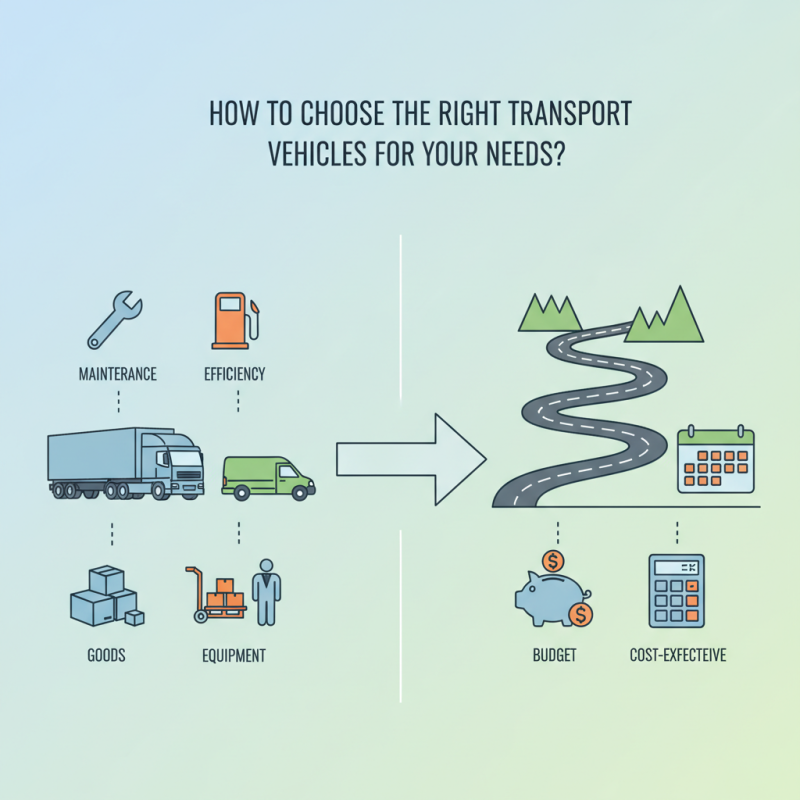
How to Choose the Right Transport Vehicles for Your Needs?
Choosing the right transport vehicles is crucial for efficiency. Various options suit different needs, from trucks to vans. Each vehicle type has unique capabilities.
Consider your specific requirements. Are you transporting goods, equipment, or people? The size and weight of your cargo influence your decision significantly. Additionally, assess the terrain and distance. Some transport vehicles perform better in challenging conditions.
It’s important to reflect on your budget too. The most expensive option isn’t always the best. Maintenance costs, fuel efficiency, and reliability matter. Take your time to research and think about your choices. Sometimes, the perfect vehicle may not exist. Adapting your needs can lead to better solutions.
Understanding Your Transport Needs: Key Considerations
Choosing the right transport vehicles requires a deep understanding of your specific needs. Analyze your cargo type—size, weight, and fragility. For instance, converting raw data from the Bureau of Transportation Statistics reveals that almost 70% of freight is moved via trucks in the U.S. Clearly, efficiency drives the need for appropriate vehicles.
Consider the vehicle capacity. A truck that’s too large might not be cost-effective. On the flip side, underloading can lead to wasted space and increased trips. Research shows that optimizing load capacity can save 20% in transportation costs. It’s vital to assess how often these vehicles will be used. Seasonal variations may affect demand. If you operate in peak seasons, flexibility is key.
Transportation regulations also play a role. Compliance with vehicle regulations ensures safety and avoids fines. Yet, are you aware of local laws? Knowledge gaps can lead to operational setbacks. Review your current transport strategy and identify areas needing improvement. Data indicates that companies failing to adapt to these needs tend to face higher operational costs. Prioritizing your requirements now can lead to safer and more efficient operations.
Evaluating Different Types of Transport Vehicles
When evaluating transport vehicles, it’s essential to consider various factors. The type of goods to be transported plays a significant role. For instance, temperature-sensitive items require refrigerated vehicles, while bulky products may need flatbed trucks. According to industry reports, over 30% of logistics costs are influenced by transportation modes. Selecting the right vehicle type can greatly reduce these costs.
Tips: Assess your cargo's size and weight. This will help determine the required vehicle capacity. Don’t overlook fuel efficiency. The right choice can lead to substantial savings over time.
Another vital aspect to evaluate is terrain. Off-road vehicles are necessary for rural deliveries, while vans suit urban settings better. A report from a logistics analysis suggests that nearly 40% of transport inefficiencies arise from mismatched vehicle types.
Tips: Look into the route your vehicle will take. Understand local regulations as they might restrict certain vehicle types. Finally, reflect on future needs. Will your transport requirements evolve? Adapting now can prevent costly adjustments later.
Assessing Cost-Effectiveness and Budget Constraints
Choosing transport vehicles can be challenging, especially regarding cost-effectiveness. Start by assessing your budget limitations. Determine how much you can allocate without straining your finances. This will help you narrow down your options. Also, consider the total cost of ownership. This includes fuel, maintenance, and insurance. Make a list of all potential expenses to understand the long-term financial impact.
Think about your specific needs. For example, how frequently will you use the vehicle? Will it be for long trips or short hauls? Each scenario may require different types of vehicles. It’s crucial to match the vehicle’s capabilities with your actual requirements. Sometimes, we overlook these details and choose based on initial costs alone. That can lead to higher expenses in the long run.
Gauging the resale value is another point to consider. Some vehicles depreciate faster than others. It might be wise to research the market trends related to your choices. While it's challenging, evaluating both immediate and future costs will ensure a more informed decision. Making an impulsive choice can cause regret later on. Always reflect on what truly meets your needs before committing.
Exploring Environmental Impact and Sustainability Options
Choosing the right transport vehicles involves considering environmental impact and sustainability. Many people overlook this crucial factor. Factors like fuel type, emissions, and lifecycle are important. Electric and hybrid vehicles are gaining traction. They offer a cleaner alternative to traditional gas-powered vehicles. However, charging infrastructure can be a challenge in some areas.
Tips: Assess your area’s charging options before committing. Evaluating your local infrastructure can help you avoid future inconveniences. Also, consider how much you drive. If you are not traveling far, a smaller vehicle might be sufficient.
Looking into materials is also key. Some vehicles utilize sustainable materials in their construction. This practice reduces the overall environmental footprint. While these options may seem appealing, they often come at a higher cost. Balancing eco-friendliness with budget is not always easy. Reflecting on these trade-offs is necessary.
Tips: Research the materials used in potential vehicles. Make sure the benefits outweigh the costs for your specific needs. The most sustainable option is not always the most practical. Consider your daily requirements and make an informed choice.
Vehicle Emissions and Sustainability Ratings
This chart illustrates the emissions in grams of CO2 per kilometer for various transport vehicles, alongside their sustainability ratings based on typical fuel efficiency and eco-friendliness.
Choosing Based on Accessibility and Operational Efficiency
Choosing the right transport vehicles involves careful consideration of accessibility and operational efficiency. Many organizations overlook these factors in their decision-making. According to a 2022 report by the Transportation Research Institute, around 65% of logistics companies face accessibility challenges. These challenges often lead to delays and increased costs, ultimately affecting overall efficiency.
Operational efficiency is crucial. The same report indicates that companies optimizing vehicle selection can reduce operational costs by up to 30%. Smaller vehicles often navigate urban areas more effectively, reducing travel time. However, selecting larger vehicles could be beneficial for bulk transport, despite their higher fuel consumption. Finding the right balance is essential.
Accessibility is not just about physical features. It also includes the driver's experience and vehicle reliability. Vehicles that lack modern features may hinder operational efficiency, leading to missed opportunities. Investing in technology can improve real-time tracking and route planning, enhancing overall performance. Organizations must continuously assess their choices to adapt to changing needs.