
Top Sofa Feet Manufacturers in China

A sofa can look refined in a showroom and still disappoint when its feet wobble, scratch the floor, or loosen after months of use. That is why choosing Sofa Feet suppliers deserves more than a quick price comparison. Furniture designer Charles Eames captured the value of small details: “The details are not the details. They make the design.” His observation applies here: a short leg changes a sofa’s stance, while a poorly finished metal foot can mark a pale wooden floor.

This guide to Top Sofa Feet Manufacturers in China focuses on practical points buyers can check. Look at materials, finish consistency, mounting plates, screw patterns, dimensions, and the supplier’s approach to sample evaluation. Ask whether load tests and inspection records are available, and compare the production sample with the approved drawing. A close-up photo helps, but it is not proof of fit. Not every supplier publishes the same level of technical information; that gap deserves a question, not an assumption.

Small differences matter. A few millimeters can affect clearance beneath a sofa or alignment across a set of legs. Buyers should also discuss order quantities, packaging, lead times, and how finish variation is handled. This overview is a starting point, not a substitute for testing parts against your own frame and specifications. Sometimes the least impressive detail causes the most rework. A careful shortlist can help identify Chinese manufacturers suited to your design, quality needs, and production schedule.
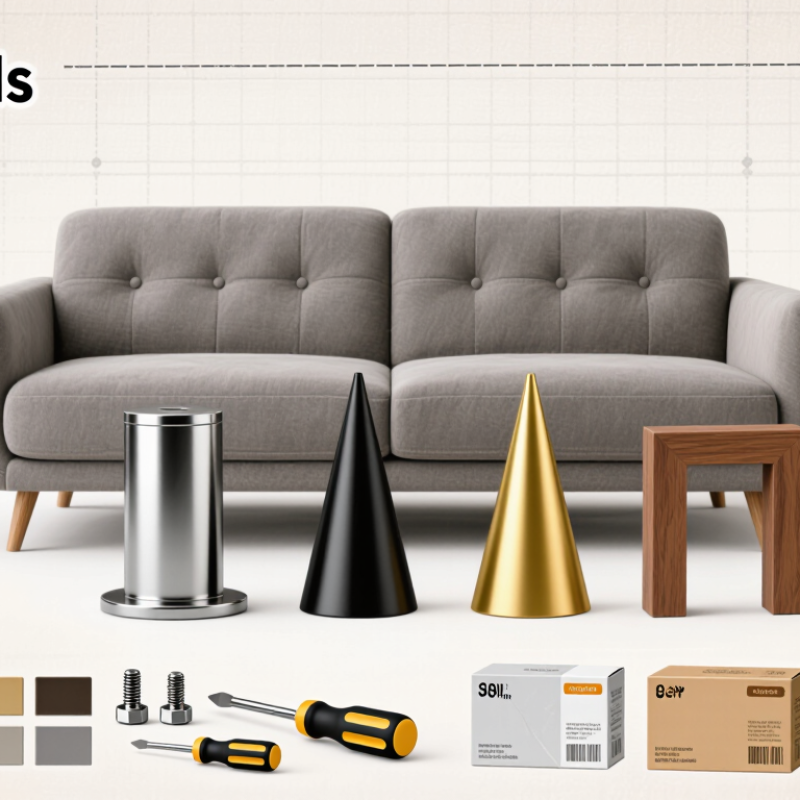
Top Sofa Feet Manufacturers in China

Sofa Feet in China: Definition, Functions, and Main Product Types

Sofa feet are the supports fixed beneath a sofa’s base or frame. They transfer weight to the floor, raise the seat, and help keep the furniture stable. A few centimetres of clearance can make vacuuming easier and reduce direct contact between upholstery and floor dust. Small parts, but not trivial.

China’s National Bureau of Statistics reported that furniture manufacturers above designated size generated 655.7 billion yuan in revenue in 2023, down 4.4% year on year. This broad industry figure, not a sofa-foot market estimate, shows the scale of furniture production behind component demand. Common feet include solid-wood legs, steel or aluminum supports, molded-plastic feet, and adjustable glides. Shapes range from short blocks to tapered legs and slim metal frames. Each type changes the sofa’s appearance and affects its load path, floor contact, and cleaning clearance.

For buyers, material alone is not enough. Check the mounting plate, screw spacing, leg angle, and stated load capacity against the sofa frame. Metal may suit a heavier frame, while wood gives a warmer finish; either can fail if poorly fixed. Adjustable glides help on uneven floors. Still, product descriptions do not always explain how load ratings were tested, so that detail deserves a closer look. A foot can look minor. It is not.

Sofa Feet in China: Definition, Functions, and Main Product Types

Representative material densities for common sofa-foot materials

Sofa feet elevate and support a sofa, help keep its base clear of the floor, and contribute to its appearance. Common material options include plastics, wood, and metals. The chart compares approximate material densities in grams per cubic centimeter; actual values vary by grade, composition, and, for wood, moisture content. Density is a material property, not a measure of a sofa leg’s load capacity.

Materials and Dimensions: Comparing Metal, Wood, and Polymer Components

For sofa feet, material changes both load behavior and the visible profile. Steel is dense at about 7.85 g/cm³; aluminum is roughly 2.70 g/cm³, according to standard engineering material data. Steel suits slim, rigid legs, while aluminum reduces weight during handling. Finish matters too: inspect welds, coating coverage, and the mounting plate, not just the leg. Small details count.

Wood feels warmer, but species and moisture affect weight and movement. The USDA Forest Products Laboratory’s Wood Handbook reports average density near 28 lb/ft³ for eastern cottonwood and 38 lb/ft³ for black walnut at 12% moisture content. That difference can affect handling and fastening. Polymer feet can be light and shape-flexible, but resin grade and wall thickness determine stiffness. PlasticsEurope reported 400.3 million tonnes of global plastics production in 2022; that figure does not guarantee a component’s quality. Check dimensions closely: a 100–150 mm leg changes seat height and floor clearance, while an M8 or M10 fixing must match the frame. Measure twice. One trade-off is easy to miss: taller feet may look elegant, yet can make a sofa feel less stable if their footprint is narrow.

Top Sofa Feet Manufacturers in China – Materials and Dimensions: Comparing Metal, Wood, and Polymer Components

Material Typical Sofa-Foot Dimensions Common Mounting Options Material Reference Practical Characteristics Suitable Use Considerations
Steel Common furniture-leg heights are approximately 100–150 mm. Metal tube or plate dimensions vary by design; mounting plates are often specified separately. Top plate with screw holes; threaded stud or insert, often M8 or M10 where specified by the design. Density is approximately 7.85 g/cm³ for carbon steel. Rigid and durable; steel components may be plated, painted, or powder-coated. Protective finishes help limit corrosion. Useful where a slim profile or a sturdy metal appearance is desired. Confirm the mounting plate, fasteners, and floor-protection pads for the intended sofa.
Aluminum Common furniture-leg heights are approximately 100–150 mm; profiles may be tubular, cast, or machined. Top plate, threaded stud, or an integrated bracket, depending on the leg design. Density is approximately 2.70 g/cm³ for aluminum. Lighter than steel and naturally forms a protective oxide layer. Appearance and surface durability depend on the alloy and finish. Consider when lower component weight is useful. Check the leg geometry and attachment details rather than comparing material alone.
Solid wood Common heights are approximately 100–150 mm. Tapered or angled legs often have a wider upper section and a narrower foot. Wood screws through a mounting plate; a threaded insert or hanger bolt may also be used. Density varies by species and moisture content; many furniture hardwoods fall broadly around 0.6–0.9 g/cm³. Natural grain and color vary. Wood can be stained, sealed, or painted; dimensions and moisture content should be controlled to reduce movement. Works well for warm, traditional, or natural finishes. Inspect grain, joints, and the area around screw holes when assessing a component.
Polypropylene (PP) Common molded feet are approximately 30–100 mm high; larger or taller designs depend on the mold and internal reinforcement. Molded screw holes, a mounting plate, or a threaded insert incorporated into the part. Typical density is approximately 0.90–0.91 g/cm³. Lightweight and suitable for molded shapes. Performance depends on grade, wall thickness, geometry, and exposure conditions. Often used for concealed feet, glides, or cost-conscious designs. Verify the specified load rating and attachment method for the finished product.
Polyamide (nylon) Common molded furniture feet and glides are approximately 20–80 mm high; dimensions vary with the support and mounting design. Snap-in fitting, screw attachment, or a molded-in threaded insert, depending on the application. Unfilled nylon typically has a density around 1.13–1.15 g/cm³; glass-filled grades are denser. Can provide good wear resistance in suitable grades. Nylon absorbs moisture, which can affect dimensions and mechanical properties. Consider for molded supports or sliding-contact parts. Confirm the polymer grade and whether a separate floor-protection pad is required.

Note: Dimension ranges are indicative examples for furniture components, not a universal standard. Actual sizes, thread types, finishes, and load ratings vary by design. Confirm product drawings and test data before selection.

Manufacturing Processes: Casting, CNC Machining, Welding, and Finishing

Sofa feet quality begins with process selection. Casting creates sculpted profiles and thicker load-bearing sections, but trapped gas can leave pores. CNC machining squares mounting faces and drills repeatable screw holes. Fit matters. For welded steel feet, jigs control angles while operators check weld continuity and distortion. Finishing starts with cleaning and pretreatment. Powder coating protects surfaces, yet thin coverage around corners may chip first. A sample should be tested, not merely admired.

The American Foundry Society’s 2023 Census of World Casting Production reported that China produced about 51 million metric tons of castings in 2022. This indicates substantial casting capacity, not guaranteed sofa-foot quality. Ask manufacturers for material specifications, dimensional inspection records, weld checks, and coating adhesion or corrosion-test results. Also ask how they track rejects. Small details matter.

Tips: Inspect the underside of a finished foot, where machining marks and coating gaps may appear. Compare hole spacing with your frame drawing, and request a load test on the assembled set. A polished sample can still differ from batch production, so confirm inspection frequency and retain the approved sample for comparison.

Quality Evaluation: Strength and Durability Tests Under ISO 7173

Top Sofa Feet Manufacturers in China

ISO 7173 provides methods for assessing the strength and durability of seating, including load and repeated-use tests. For sofa feet, the test setup matters: the feet should be evaluated as part of the assembled frame, not only as isolated metal or wooden components. The standard does not offer one universal pass load for every sofa design. Lab reports should therefore identify the test configuration and conditions.

When comparing manufacturers, request the actual report data: applied force, completed cycles, permanent deformation, and observed failure mode. Check for loosened fasteners, cracked welds, split wood, or a foot that shifts on a hard test surface. Small details count. A foot may look solid yet twist under repeated loading. Ask whether the tested sample matches the production material, finish, and attachment hardware; otherwise, the result may not represent delivered goods.

ISO 7173 is a test-method standard, not a market-wide performance survey, so avoid treating one supplier’s result as a universal benchmark. Compare reports only when test conditions are similar. Also confirm with the laboratory that its method appropriately covers the sofa configuration, since seating designs vary. A slightly uneven result deserves a second look, not a quick pass.

Chinese Manufacturer Profiles: Product Range, Capacity, MOQ, and Export Markets

Top Sofa Feet Manufacturers in China

Chinese sofa-foot manufacturers typically offer solid wood, metal, plastic, and mixed-material designs. Product ranges may include tapered legs, angled feet, concealed supports, and adjustable options. Finishes can range from natural wood tones to matte black or brushed metal. Ask for material specifications, load-test details, and finish samples. A polished catalog is not enough.

Production capacity depends on tooling, material availability, and order complexity. A factory may handle standard models in larger batches but require more time for custom dimensions or colors. Minimum order quantities vary, too; confirm them for each material and finish, rather than relying on a general figure. Export experience may cover markets in Europe, North America, or elsewhere, but buyers should verify destination-specific packaging and documentation with the supplier. Capacity claims need context. Sometimes, a smaller workshop offers closer sample control, though delivery planning may be less predictable. That trade-off deserves thought.

Tips: Request a pre-production sample and check screw fit, stability, and finish under bright light. Ask for recent production photos and a written lead-time range. Small details matter.

Go to Top