Top Stainless Steel Manufacturers for Global Buyers

Global buyers need more than a polished catalog when selecting stainless steel manufacturers. They need traceable quality, stable capacity, and evidence that survives an audit. The International Stainless Steel Forum reported global crude stainless steel production at approximately 58.4 million tonnes in 2023. That scale signals strong demand, but it also hides uneven performance among suppliers. A mill may offer attractive prices while lacking consistent chemistry, surface control, or delivery discipline.

This guide examines leading stainless steel manufacturers through practical buying criteria. These include grade accuracy, melting technology, testing systems, export experience, and environmental reporting. World Stainless states that stainless steel contains an average of 60% recycled content globally, supporting its circular-material value. Tim Collins, Secretary General of World Stainless, has described stainless steel as “a material for the future.” The phrase sounds optimistic. Yet buyers should test it against production records, third-party certificates, and actual shipment results.

The World Steel Association also highlights steel’s essential role in infrastructure, transport, energy, and manufacturing. Stainless steel extends that role into food equipment, chemical processing, architecture, and medical applications. Small details matter: a clean coil edge, a readable heat number, and packaging that prevents salt-air corrosion. Not every manufacturer performs equally well. That is the uncomfortable part.

This overview compares stainless steel manufacturers using documented capabilities rather than marketing language. It considers both established producers and competitive regional suppliers. Buyers should still verify current certifications, mill capacity, and country-specific compliance before signing contracts. No ranking can replace careful due diligence.
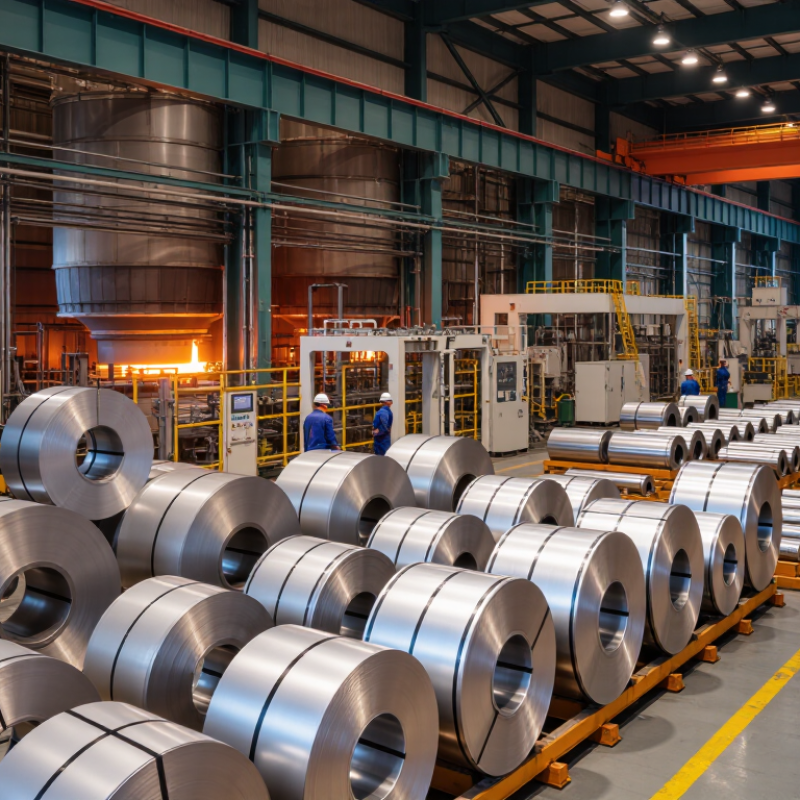
Top Stainless Steel Manufacturers for Global Buyers

What Makes a Stainless Steel Manufacturer Globally Competitive

Global buyers judge stainless steel manufacturers by more than price. Consistent chemistry, accurate dimensions, and reliable delivery matter across borders. The International Stainless Steel Forum reported approximately 58.4 million tonnes of global crude stainless steel production in 2023. This scale increases competition, but it also raises quality expectations.

Traceability is a practical differentiator. A competitive mill should connect each coil to heat numbers, inspection records, test results, and shipment documents. Buyers also need clear support for grades, welding, forming, and corrosion resistance. ISO 9001 certification helps, but a certificate alone proves little. Factory audits should examine calibration, surface inspection, nonconformance handling, and corrective actions. Small gaps become expensive after installation.

Sustainability now affects purchasing decisions. The World Steel Association’s 2024 World Steel in Figures recorded global crude steel output at about 1.89 billion tonnes in 2023, showing the industry’s enormous environmental footprint. Manufacturers that measure energy, emissions, water, and recycled content can provide more credible comparisons. However, environmental claims remain uneven. Buyers should request verified data, not attractive wording. A supplier may offer excellent steel yet communicate poorly, and that weakness can still damage a project. Competitiveness is therefore operational, technical, and transparent.

Key Stainless Steel Grades, Products, and Manufacturing Capabilities

Global buyers need more than a polished catalog when selecting stainless steel manufacturers. They should examine grades, product forms, and production controls together. Austenitic 304 remains common for food equipment, tanks, and architectural panels. Grade 316 offers stronger resistance to chlorides and suits coastal facilities, chemical processing, and marine environments. Ferritic and martensitic grades can reduce cost or improve hardness, but their welding and corrosion performance require closer review.

Reliable manufacturers usually supply stainless steel sheets, plates, coils, pipes, tubes, bars, fittings, and custom-fabricated parts. A capable facility should show clear control of melting, hot rolling, cold rolling, annealing, pickling, slitting, and surface finishing. Ask for heat numbers, mill test certificates, dimensional reports, and independent inspection options. Small details matter. A brushed sheet with uneven lines may fail an architectural installation, even when its chemistry is correct.

Manufacturing experience is visible in practical questions. Can the supplier maintain thickness tolerance across a wide coil? Can it prevent contamination during storage? Does it understand solution annealing and passivation for the intended service? These answers reveal more than marketing language. Buyers should also confirm minimum order quantities, packing methods, lead times, and export documentation. No supplier is perfect. A careful review may expose weak communication or inconsistent surface quality before it becomes an expensive problem.

Top Stainless Steel Manufacturers for Global Buyers

Key Stainless Steel Grades, Products, and Manufacturing Capabilities

What the chart shows: Representative chromium, nickel, and molybdenum content by weight for widely traded stainless steel grades. Actual chemical limits vary by applicable ASTM, EN, or JIS specification and product form.

Buyer perspective: Common stainless steel manufacturing capabilities include electric arc melting, AOD or VOD refining, continuous casting, hot and cold rolling, annealing, pickling, surface finishing, cutting, welding, and mechanical and chemical testing. Typical products include coils, sheets, plates, bars, wire, pipes, tubes, and fabricated components.

How to Evaluate Quality, Certifications, and Production Reliability

Top Stainless Steel Manufacturers for Global Buyers

Quality evaluation should begin with traceable evidence, not polished brochures. The World Stainless Association reported global stainless crude steel production of about 58.4 million tonnes in 2023. Such scale increases competition, but also makes process control essential.

Buyers should review chemical test results, heat numbers, surface inspection records, and thickness tolerances. Compare results with the agreed ASTM, EN, or JIS specification. A bright surface can still hide poor corrosion resistance.

Certifications support trust, but they do not replace factory verification. Check the certificate scope, issuing body, expiry date, and manufacturing location. ISO 9001 shows a quality management system; it does not guarantee every coil or pipe is perfect.

Request EN 10204 3.1 inspection certificates for critical orders. Production reliability needs measurable proof. Ask for on-time delivery, rejection rates, corrective-action records, and recent audit findings. A supplier reporting only “zero defects” may be oversimplifying reality.

Tips: Request three recent batch records. Confirm heat numbers match packing labels. Arrange a remote or independent inspection before shipment. Test a small order first. That step is often overlooked.

Also examine capacity during peak seasons, maintenance planning, backup equipment, and raw-material purchasing. World Stainless production data shows a large, active market, but volume alone cannot prove consistency. I would treat unusually low prices as a signal for deeper questions, not automatic evidence of poor quality.

Leading Stainless Steel Manufacturing Regions and Supplier Profiles

Stainless steel production is concentrated in regions with strong raw material networks, engineering skills, and export infrastructure. East Asia offers broad capacity, competitive processing, and many finish options. Suppliers there commonly produce coils, sheets, tubes, and precision components for construction and industrial equipment.

South Asia has become important for fabricated products and cost-sensitive projects. Its supplier profiles often include flexible order quantities and practical customization. European mills are known for strict process control, traceability, and advanced surface finishing. North American suppliers often serve demanding energy, food-processing, and infrastructure applications. Regional strengths vary, so location alone should not determine a purchase.

A dependable supplier should provide mill certificates, heat numbers, chemical analysis, and mechanical test results.

Buyers should also confirm compliance with the required ASTM, EN, or project-specific standard. Ask about grade consistency, thickness tolerance, weld quality, packaging, and port handling.

Small details matter.

A visit or independent inspection can reveal storage problems, mixed bundles, or incomplete records. Even experienced buyers sometimes trust a polished sample too quickly. That is a weakness worth correcting.

Compare production capacity with the supplier’s actual equipment, not only its website claims. Clear communication about delivery windows, surface finish, and rejection procedures reduces costly misunderstandings.

The best profile is not always the largest producer. It is the supplier that can repeatedly meet documented requirements under real shipping and inspection conditions.

Essential Factors for Global Buyers When Choosing a Manufacturer

Top Stainless Steel Manufacturers for Global Buyers

Choosing a stainless steel manufacturer requires more than comparing prices. The International Stainless Steel Forum reported approximately 58.4 million tonnes of global stainless crude steel production in 2023. This scale creates many options, but quality can vary sharply. Buyers should verify the exact grade, such as 304 or 316L, and request mill certificates, heat numbers, and independent test results. Certificates should match the delivered coils, sheets, or pipes, not only a sample batch.

Production capacity also matters. Ask about monthly output, forming limits, surface finishes, and export experience. A reliable manufacturer can explain tolerances using recognized ASTM, EN, or ISO requirements.

Their quality system should include chemical analysis, mechanical testing, dimensional checks, and documented corrective actions. ISO 9001 certification is useful, but it is not proof of perfect product quality. That assumption deserves scrutiny.

The World Steel Association recorded nearly 1.89 billion tonnes of crude steel production in 2023, showing how large and competitive the wider supply chain has become.

Tips: Compare total delivered cost, not just the factory quote. Check packaging, port handling, insurance, duties, lead time, and payment risk. Request a small trial order before a major contract. Inspect edge protection and moisture barriers when containers arrive. Keep communication written and measurable. A clear inspection plan prevents expensive arguments later. Sustainability should also be assessed through energy data, recycled content, emissions reporting, and credible third-party verification. The cheapest option may be the least economical.

Go to Top