
What Are the Top Types of Stainless Steel Mesh?
Stainless steel mesh looks simple on a roll: bright wire, square openings, clean edges. Choosing the right type is less simple. Woven mesh bends around a frame; welded mesh holds a rigid grid; knitted mesh flexes, while expanded mesh forms openings without woven strands. Each construction changes strength, airflow, filtration, and installation. Small differences matter.
The World Stainless Association reported 58.4 million tonnes of global stainless steel melt-shop production in 2023. That figure describes stainless steel overall, not mesh demand, but it shows the scale of its material supply. Materials scientist Michael F. Ashby’s materials-selection approach offers a useful reminder, paraphrased here: “Choose materials for their service conditions, not their labels.” For mesh, that means checking alloy grade, wire diameter, aperture, finish, and exposure—not just comparing price per roll.
There is no universal best mesh. A fine screen may capture smaller particles but clog sooner; a heavier weave may last longer yet restrict flow. Trade-offs are real. Even a polished sample can mislead if its wire size or alloy differs from the delivered product. This guide compares the main stainless steel mesh types, explains where each fits, and highlights the details worth confirming before purchase. Small details count.
How Stainless Steel Mesh Types Are Classified
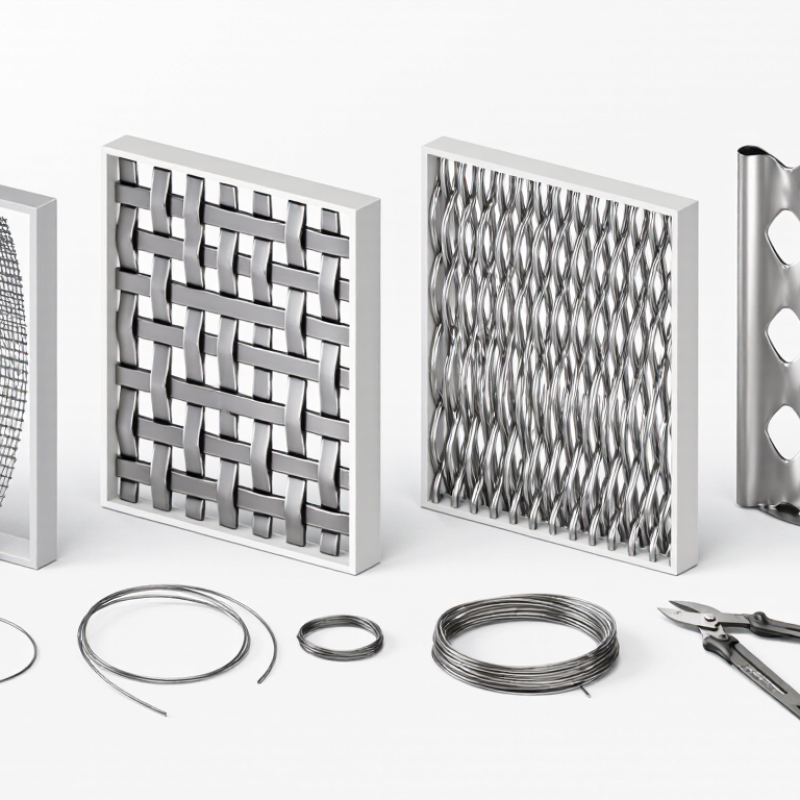
Stainless steel mesh is best classified by how it is made, how its wires cross, and the size of its openings. Woven mesh has interlaced wires; welded mesh joins wires at crossing points. Expanded mesh is cut and stretched from a sheet, so it has no separate wire intersections. ISO 9044:2016 sets technical definitions and tolerances for industrial woven wire cloth, while ASTM E2016 describes specifications for industrial woven wire cloth. These references help buyers compare measurable properties instead of relying on labels alone.
Within woven mesh, plain weave alternates over and under each wire, while twill weave passes over two or more wires. Dutch weave uses different wire diameters in each direction and is often chosen for fine filtration. Classification also depends on mesh count, wire diameter, and aperture—the clear opening between wires. For example, 40 openings per inch with 0.25 mm wire gives an approximate aperture of 0.385 mm. Real measurements can vary with manufacturing tolerances. That matters.
Finally, specify the stainless steel grade, finish, and intended operating conditions. Corrosion resistance depends on the alloy and environment, not the mesh name alone. A specification should state aperture and wire diameter, rather than just “fine mesh.” In practice, catalog descriptions sometimes blur these categories; checking the technical drawing is a useful extra step.
What Are the Top Types of Stainless Steel Mesh? - How Stainless Steel Mesh Types Are Classified
| Mesh Type | How It Is Classified | Typical Characteristics | Common Applications | Common Stainless Steel Grades |
|---|---|---|---|---|
| Plain-Woven Wire Mesh | Wires cross alternately over and under one another in a simple weave. | Balanced construction; available in a wide range of wire diameters and opening sizes. Often selected for general filtration and screening. | Sieving, strainers, guards, and general-purpose filtration. | 304, 316, and 316L |
| Twill-Woven Wire Mesh | Each wire passes over and under two or more wires in a repeating pattern. | Allows heavier wires to be woven at a given mesh count than plain weave; commonly used when a sturdy, fine-screen construction is needed. | Fine filtration, particle separation, and process screens. | 304, 316, and 316L |
| Dutch-Woven Wire Mesh | Uses different wire diameters and weave patterns, commonly with closely spaced warp wires and heavier weft wires. | Designed for fine filtration; openings can be small and tortuous, so it is generally specified by filtration characteristics rather than a simple mesh count alone. | Liquid and gas filtration, hydraulic systems, and process filtration. | 304, 316, and 316L |
| Welded Wire Mesh | Wires are arranged in a grid and joined at their intersections by welding. | Rigid, stable panels with consistent square or rectangular openings; the welded joints help maintain the grid shape. | Machine guards, screens, partitions, racks, and architectural panels. | 304 and 316 |
| Knitted Wire Mesh | Continuous wire is formed into interlocking loops, similar to a knitted fabric. | Flexible and compressible; may be supplied as mesh fabric or formed into pads and other shapes. | Demisters, mist eliminators, cushioning, and separation components. | 304 and 316 |
| Expanded Metal Mesh | Sheet metal is slit and stretched to form interconnected strands and diamond-shaped openings, without separate woven wires. | One-piece construction with no woven or welded intersections; opening shape and strand dimensions depend on the expansion pattern. | Walkways, ventilation panels, protective screens, and architectural features. | 304 and 316 |
| Perforated Stainless Sheet | Openings are punched or otherwise formed in a stainless steel sheet in a specified pattern. | Sheet-based rather than woven wire; hole shape, spacing, and open area can be selected for the intended use. | Acoustic panels, screens, ventilation covers, and filtration supports. | 304 and 316 |
Related Posts
-

How to Choose the Best Stainless Steel Mesh for Your Needs?
-
2025 How to Choose the Best Stainless Steel Mesh Screen for Your Needs
-
Essential Tips for Choosing the Right Stainless Steel Mesh for Your Project
-
China Top Stainless Steel Mesh Screen Suppliers?
-
How to Choose the Right Steel Wire Mesh for Your Project?
-

What is Stainless Steel Mesh and Its Applications?