Choosing a stainless steel welding supplier in 2026 requires more than comparing hourly rates. The decision affects corrosion resistance, dimensional accuracy, production continuity, and long-term safety. A polished website proves little. Shop-floor evidence matters more.
John C. Lippold, a respected welding metallurgy expert, has stated, “The weldability of stainless steels depends on composition, microstructure, and service conditions.” That principle should guide every supplier review. Ask how the company controls heat input, shielding gas, interpass temperature, and post-weld cleaning. Request current WPS and PQR records, qualified welder credentials, material certificates, and traceability from coil or plate to finished assembly. These documents should connect to real production samples, not remain in a forgotten folder.
Inspect the facility if possible. Look for clean stainless-only work areas, dedicated brushes, calibrated meters, and visible inspection routines. A supplier handling food, pharmaceutical, marine, or architectural projects should understand different surface and corrosion demands. Confirm experience with your grade, thickness, joint design, and expected service environment. Price is not proof. Details decide outcomes.
A strong supplier also communicates clearly when a design is difficult. That honesty is valuable. No checklist is perfect, and even experienced teams can miss distortion, contamination, or access limitations. Buyers should compare weld quality, testing methods, delivery records, corrective-action history, and technical responsiveness. The right stainless steel welding partner does not merely complete a weld; it protects the performance of the entire product. Forecasting future needs matters, too, because automation, traceability, and lower-carbon production will increasingly influence supplier selection in 2026.
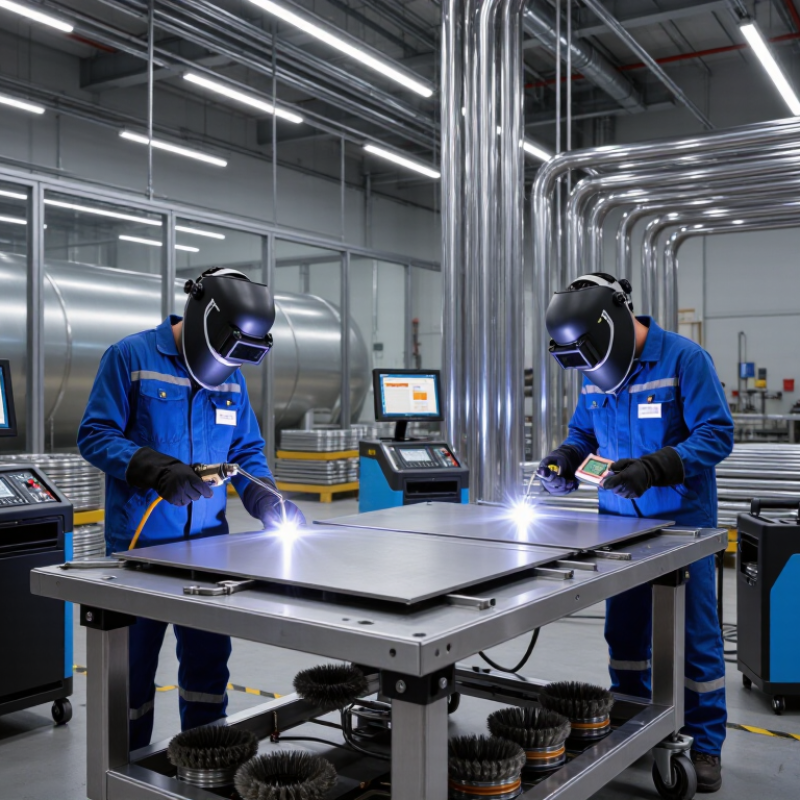
Before comparing stainless steel welding suppliers, define the work in measurable terms. Record the alloy grade, material thickness, joint design, weld position, production quantity, and required delivery dates. Describe the service environment too: chloride exposure, cleaning chemicals, operating temperature, and whether the weld will face repeated loading. These details shape process selection, filler metal, and inspection plans. Details matter. A polished sample weld proves little if it uses a different grade or thickness from your job.
Set acceptance criteria before requesting quotations. Specify dimensional tolerances, surface finish, weld appearance, testing methods, and required records, such as material traceability and welder qualifications. The NACE International IMPACT study estimated corrosion costs at US$2.5 trillion annually, or 3.4% of global GDP, in 2016. It also reported that corrosion-control practices could save 15–35% of those costs. That estimate is broad, not a forecast for one fabrication project. Still, it supports defining exposure conditions and inspection needs early. A project brief is rarely perfect on day one; note uncertain assumptions, then confirm them with engineering review before suppliers price the work.
Choosing a stainless steel welding supplier in 2026 requires more than comparing prices. Verify practical expertise, current certifications, and proven production capacity. The International Stainless Steel Forum reported global stainless steel production of about 58.4 million tonnes in 2023. That scale increases competition, but it does not guarantee consistent weld quality.
Ask for ISO 3834 certification, qualified welding procedures, and welder approvals under ISO 9606-1. Check whether certificates match the actual facility and scope of work. The ISO Survey 2022 recorded more than 1.26 million ISO 9001 certificates worldwide. Certification is common. Meaningful control is not always common. Review material certificates, weld maps, inspection records, and non-destructive testing reports. During an audit, inspect clean workstations, labeled heat numbers, calibrated equipment, and weld samples under real production conditions.
Capacity claims need evidence. Request monthly output, machine lists, shift patterns, staffing levels, and recent delivery records. Compare promised lead times with documented performance. A supplier may own many welding machines but lack qualified operators or finishing space. That weakness can appear late. Ask how the supplier handles urgent orders, rework, equipment failure, and stainless steel contamination risks. I have found that small traceability gaps often matter more than polished presentations. No audit is perfect, either. Recheck critical findings before signing a long-term agreement.
Supplier evaluation based on welding expertise, certifications, and production capacity
How to read this chart
This 100-point procurement model prioritizes welding quality systems and verified production capability. Confirm ISO 9001 quality management, ISO 3834 welding quality requirements, qualified welding procedures and personnel, traceability of stainless steel materials, inspection capability, and capacity that matches your required volume and delivery schedule.
Reference framework: ISO 9001 quality management systems, ISO 3834 quality requirements for fusion welding of metallic materials, ISO 9606-1 welder qualification testing, ISO 15614-1 welding procedure qualification, and EN 10204 material inspection documents.
Choosing a stainless steel welding supplier in 2026 requires more than comparing hourly prices. Examine weld quality through sample joints, cross-section tests, and documented inspection records. A clean bead is useful, but it does not prove penetration or corrosion resistance. Ask for welding procedure specifications, welder qualifications, and traceability from material receipt to final inspection. I have found that suppliers with consistent records usually handle production changes more reliably.
Material selection should match the service environment. 304 stainless steel may suit general fabrication, while 316L performs better around chlorides. Confirm mill certificates and use positive material identification when specifications are critical. Review technology, too. TIG welding can create precise, attractive joints, while laser or orbital systems may improve repeatability on suitable designs. Automation sounds impressive. It still needs skilled oversight. Check fixture accuracy, heat control, shielding gas management, and non-destructive testing methods.
Tips: Send drawings with tolerances, surface-finish requirements, and expected production volumes. Request a small trial batch before approving full production. Measure distortion after welding, not only before shipment. Discuss customization early, including unusual thicknesses, complex angles, polishing, passivation, and packaging. One overlooked detail can delay an entire installation. Do not rely on polished samples alone; real performance may expose assumptions your team missed.
| Evaluation Dimension | Suggested Weight | What to Compare | Evidence to Request | Warning Signs |
|---|---|---|---|---|
| Material range and grade control | 20% | Confirm the supplier can source and weld the specified stainless grades, such as 304/304L, 316/316L, or duplex grades where appropriate. Check that base metal and filler metal are selected for the application, service environment, and governing specification. | Material test certificates with grade, specification, heat or lot number, and product form; documented material identification and traceability procedures. EN 10204 Type 3.1 inspection documents may be specified when applicable. | Grades are described only as “stainless”; certificates cannot be linked to delivered material; or substitutions are made without written approval. |
| Welding qualifications and procedures | 20% | Compare the welding processes available, such as GTAW (TIG), GMAW (MIG), SMAW, or FCAW, and whether the proposed procedure suits the joint design, material, thickness, and service requirements. | Applicable welding procedure specifications and supporting procedure qualification records. Depending on the contract, check relevant qualification frameworks such as ISO 15614-1 for welding procedure tests and ISO 9606-1 for welder qualification. | Only verbal assurances are offered; qualification ranges do not cover the proposed work; or the supplier cannot identify which approved procedure will be used. |
| Inspection and weld acceptance | 15% | Review how welds are inspected and how acceptance criteria are chosen. Visual testing is common; penetrant, radiographic, or ultrasonic testing may be appropriate depending on joint geometry, material, specification, and project requirements. | Inspection and test plan, inspection records, nonconformance process, and sample reports. Confirm the applicable construction code or project specification defines testing extent and acceptance criteria. | Testing methods are quoted without agreed acceptance criteria; inspection results are not recorded; or repairs are made without documented reinspection. |
| Production technology and process control | 15% | Assess whether the equipment and production controls match the job: fit-up, heat input, shielding gas, interpass temperature where specified, distortion control, and repeatability for batch work. | Process flow, equipment list relevant to the project, operator controls, sample production records, and evidence of calibration or maintenance where required by the quality system. | Technology is presented as a sales claim with no link to process control, inspection, or the actual part requirements. |
| Corrosion protection and post-weld treatment | 10% | Ask how the supplier prevents carbon-steel contamination and manages weld discoloration, surface finish, and any specified cleaning, pickling, or passivation. Treatment needs depend on alloy, service environment, and project requirements. | Documented segregation and cleaning practices; agreed surface-finish requirements; treatment records where required. ASTM A967/A967M covers chemical passivation treatments for stainless steel parts. | One treatment is claimed to suit every application; surface requirements are not defined; or treatment chemicals and residues are not controlled. |
| Customization and design support | 10% | Compare the supplier’s ability to work from drawings or models, manufacture to agreed tolerances, accommodate revisions, and provide cutting, forming, machining, or assembly when included in scope. | Drawing review process, approved revision controls, capability samples, inspection plans for critical dimensions, and a written list of included and excluded operations. | Unclear responsibility for design changes, undocumented drawing revisions, or tolerances accepted without confirming manufacturability. |
| Quality management and traceability | 5% | Check whether material, welding, inspection, and repair records can be traced to the finished item. ISO 3834 addresses quality requirements for fusion welding of metallic materials; the applicable part and certification scope should match the work. | Quality-system scope, traceability sample, record-retention policy, and any relevant certification details verified against the project’s requirements. | Certificates are out of scope, expired, or unrelated to the manufacturing location or processes being proposed. |
| Delivery planning and packaging | 5% | Compare quoted lead time, production milestones, change handling, export or transport packaging, and protection of stainless surfaces during storage and shipment. | Written schedule assumptions, packaging method, shipment inspection checklist, and a clear process for communicating delays or shortages. | Lead time is given without assumptions; packaging risks are ignored; or delivery commitments are not linked to material availability and inspection time. |
| Scoring tip: Score each dimension from 1 (insufficient evidence) to 5 (strong, verifiable evidence), then apply the suggested weight. Treat the weights as a starting point and adjust them to the project’s governing code, service conditions, risk level, and purchase specification. Standards and qualification requirements should be confirmed for the specific contract. | ||||
Choosing a stainless steel welding supplier in 2026 takes more than comparing the lowest quote.
Ask for an itemized price covering material grade, cutting, welding, finishing, inspection, and packaging.
A quote that excludes passivation or dimensional checks may look attractive, then grow later.
Request a sample weld or a recent inspection record. Small details matter.
Lead times need the same careful review.
Ask when production begins, what could delay it, and how schedule changes are reported.
Confirm whether the quoted date includes final inspection and shipping preparation.
If a supplier promises an unusually fast turnaround, ask what capacity is reserved for your order.
Get the answer in writing.
Still, even a detailed schedule cannot remove every production surprise.
Communication and quality control often reveal how a supplier works before the first part arrives.
Share drawings with tolerances, weld locations, surface finish requirements, and material specifications.
Notice whether questions are specific or vague.
Ask how weld parameters are documented, who checks critical dimensions, and how nonconforming parts are handled.
A short weekly update can prevent a small mismatch from becoming a costly delay.
I would not treat polished emails as proof of quality; sometimes a plain, precise report is more useful.
Conversely, one missed reply may deserve a follow-up, not an immediate rejection.
After-sales support often separates a dependable supplier from a cheap one. Ask for a written response-time policy, spare-parts list, and technician coverage before signing.
For welding equipment, that difference may involve fewer production stoppages, cleaner welds, and less emergency freight.
Request practical evidence, not polished promises. A capable supplier should provide welding procedure guidance, consumable storage advice, and remote troubleshooting records. Check whether technicians understand stainless steel’s heat control, distortion risks, and contamination sensitivity.
During evaluation, ask for a sample service ticket. Does it identify the fault, corrective action, and follow-up date?
Small details matter. Very much.
The International Organization for Standardization’s ISO 55001 framework emphasizes planned asset management, performance monitoring, and continual improvement. Use these principles when comparing suppliers. Measure spare-part availability, training hours, inspection support, and average repair closure time.
A supplier may offer a 24-hour hotline, yet respond slowly in practice. That is a weakness worth recording. I would also test one minor service request before a major purchase. It may feel excessive, but real support often looks less impressive than sales material. Leave room for review, because even a well-designed evaluation can miss regional technician shortages or delayed parts.