What Is the Best Stainless Steel Wire Rope from China?

Choosing the best stainless steel wire rope from China requires more than comparing price lists. Material grade, construction, breaking load, surface finish, and traceability all matter. A polished 316 rope may resist salt spray better than a 304 rope, but it still needs correct sizing and inspection.

Grand View Research reported that the global wire rope market was valued at approximately USD 10 billion in 2023. Its forecast also indicates continued growth through 2030, supported by construction, marine, lifting, and industrial applications. The report does not prove that one Chinese supplier is automatically superior. It shows why buyers should examine manufacturing quality carefully.

The useful details are often physical. Look for heat numbers on certificates, consistent lay length, clean strand formation, and sealed packaging. Ask whether tensile testing follows recognized standards, such as EN 12385 or ASTM A603, where applicable. Confirm the actual stainless grade through mill documentation, not only a product webpage.

George A. Costello, a respected wire-rope researcher, described the product simply: “A wire rope is a machine.” Each wire moves under load. Small defects can become serious weaknesses.

That principle shapes this guide. It compares Chinese manufacturers through evidence, not slogans. However, no ranking is perfect. Supplier data may be incomplete, and published specifications can differ from delivered goods. Independent inspection remains wise for critical applications.

The best stainless steel wire rope is therefore not always the cheapest, brightest, or strongest-looking option. It is the rope whose metallurgy, construction, testing, and service suitability can be verified.
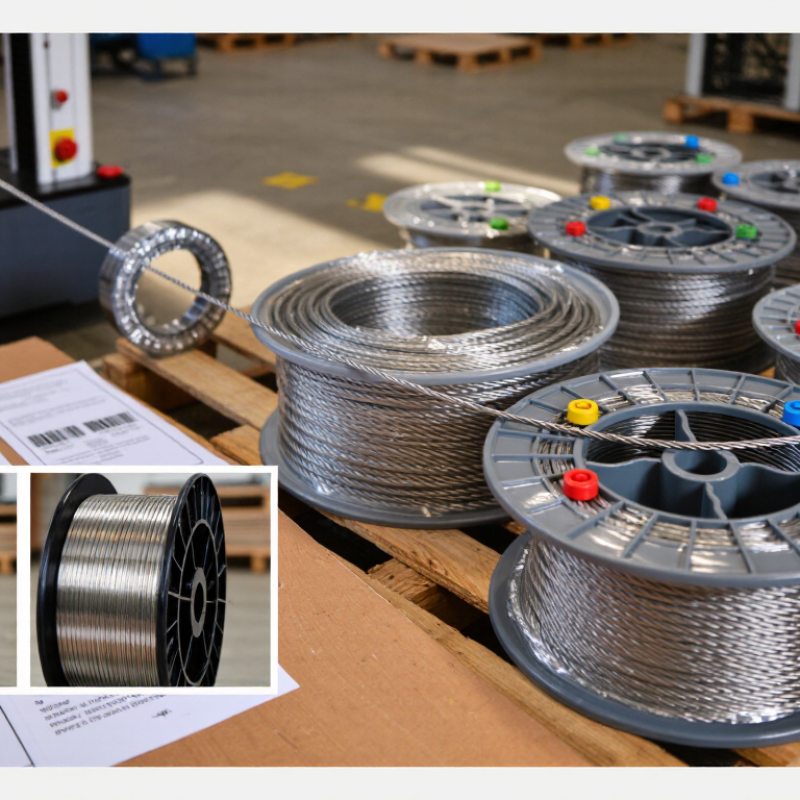
What Is the Best Stainless Steel Wire Rope from China?

Types of Stainless Steel Wire Rope Made in China

What Is the Best Stainless Steel Wire Rope from China?

Types of Stainless Steel Wire Rope Made in China

Chinese manufacturers produce stainless steel wire rope in several practical constructions. The common grades are 304 and 316 stainless steel. Grade 304 suits indoor equipment, decoration, and general lifting environments. Grade 316 offers stronger resistance to saltwater, chlorine, and coastal moisture. It usually costs more.

A 1x19 construction has nineteen wires arranged into one firm strand. It offers low stretch and a clean, straight appearance. This type works well for railing, architectural tension systems, and cable balustrades. A 7x7 rope bends more easily than 1x19 rope. It suits guide cables, light rigging, and pulley systems. A 7x19 rope provides even greater flexibility. However, its many wires may wear faster under heavy abrasion.

Some factories also make compacted, PVC-coated, and rotation-resistant versions. PVC coating improves handling and protects nearby surfaces. It can hide early corrosion, though, so inspection becomes less obvious. That detail is easy to overlook. Diameter, breaking load, lay direction, and surface finish should match the working conditions.

Reliable purchasing requires more than comparing prices. Request material certificates, tensile-test reports, construction details, and production samples. Check whether the measured diameter matches the stated tolerance. Ask about salt-spray testing when marine exposure is expected. A polished surface may look excellent, but appearance does not prove strength. In my view, 316 7x19 rope is a flexible choice for many outdoor applications. It is not automatically the best option. High loads, sharp bends, and repeated cycling may require a different construction.

Key Standards for Evaluating Stainless Steel Wire Rope Quality

What Is the Best Stainless Steel Wire Rope from China?

Key Standards for Evaluating Stainless Steel Wire Rope Quality

The best stainless steel wire rope is not identified by polish alone. In practical inspections, confirm the steel grade, rope construction, diameter tolerance, and breaking force. AISI 304 and 316 are common choices, but 316 usually offers stronger resistance in chloride-rich environments. The choice still depends on exposure, load, and maintenance.

ISO 2408 defines requirements for steel wire ropes, including construction, inspection, and minimum breaking force. That force depends on rope diameter, wire strength, core type, and lay direction. An 8 mm rope is not automatically safe. ASTM A580/A580M also provides requirements for stainless steel wire, including chemical composition and mechanical properties. Ask for a heat number and material test certificate. Traceability matters.

EN 12385 highlights manufacturing controls and safety information. Verify tensile tests, visual inspection records, and dimensional reports against the purchase specification. The International Stainless Steel Forum reported global stainless steel production of about 58.4 million tonnes in 2023. Large output does not guarantee consistent rope quality. It only shows market scale.

A useful factory check includes measuring six points along the rope, testing lubricant coverage, and examining broken wires under magnification. The surface may look excellent while internal damage develops. This is easy to miss. I would also request independent sampling, because supplier documents can contain errors. No certificate should replace a physical inspection.

How to Compare Chinese Wire Rope Materials and Construction

What Is the Best Stainless Steel Wire Rope from China?

How to Compare Chinese Wire Rope Materials and Construction

The best stainless steel wire rope depends on its working environment, load, and construction. In practical inspections, I compare the steel grade before checking the surface finish. Grade 304 suits many indoor and mild outdoor applications. Grade 316 offers better resistance around saltwater and chemical exposure. However, a higher grade does not repair poor manufacturing.

Looks can mislead. Measure the evidence.

Ask for material certificates, tensile test results, and traceable heat numbers. Reliable suppliers should identify the wire diameter, breaking load, and production standard clearly. Check whether the rope uses a fiber core or steel core. A fiber core bends easily and protects delicate sheaves. A steel core supports heavier loads and resists crushing. The correct choice depends on pulley size and repeated movement.

Construction also changes performance. A 7x19 rope offers flexibility for control cables and moving systems. A 1x19 rope is stiffer and often suits straight, tensioned applications. Inspect strand uniformity, lay consistency, end cutting, and lubricant coverage. A loose strand is not a minor cosmetic issue. It may indicate uneven tension during closing.

Salt-spray results help, but they do not copy real service conditions. I once focused too heavily on polished surfaces and overlooked dimensional tolerance. That was a useful mistake. Compare samples under tension, measure actual diameter, and review inspection records from the same production batch. Small differences can affect fitting security and service life.

Manufacturing and Quality Control Practices to Examine

Choosing the best stainless steel wire rope from China starts with the factory floor, not the sales brochure. China produced about 1.005 billion tonnes of crude steel in 2024, according to World Steel Association data. That scale supports strong material access, but it does not guarantee consistent rope quality. Buyers should request heat numbers, stainless grade verification, and mill certificates for every production lot.

Manufacturing control should follow ISO 2408 requirements for wire ropes. Inspect wire diameter, lay length, strand balance, and surface defects during production. Confirm breaking force through laboratory testing, not calculation alone. ASTM A1023/A1023M also provides useful guidance for testing and inspection. Ask whether the factory uses calibrated tensile machines and records calibration dates. A clean test report is useful. Raw test records are better.

Quality control must continue after stranding and closing. Check rope diameter at several points, inspect lubrication coverage, and test samples from different reels. The ISO Survey 2023 recorded more than 1.2 million ISO 9001 certificates worldwide, yet certification alone cannot prove process discipline. I would examine corrective-action records and rejected batches. That part is often uncomfortable. A factory with zero defects may simply record too little. Independent witnessing can improve confidence, especially for lifting applications. Small details matter: traceability tags, sealed packaging, dry storage, and clear inspection photos.

What Is the Best Stainless Steel Wire Rope from China?

Reference tensile-strength grades commonly used in wire-rope standards are shown below. A higher grade indicates greater nominal wire tensile strength, but the rope’s actual breaking force also depends on diameter, construction, core, lay, and manufacturing quality.

Quality-control note: When evaluating a supplier, request material certificates, dimensional inspection records, visual and surface checks, lay and construction verification, and a documented breaking-force test report for the exact rope specification.

Choosing the Best Stainless Steel Wire Rope for Each Application

When selecting stainless steel wire rope from China, match the rope to the application, not just the price. Marine railings need strong corrosion resistance, while indoor lifting may prioritize breaking strength and flexibility. For coastal exposure, 316 stainless steel usually resists salt better than 304. Still, alloy choice alone does not guarantee service life.

Check the rope construction carefully. A 7×19 rope bends easily around smaller sheaves, while a 1×19 rope stays straighter for architectural tensioning. Confirm diameter, lay direction, tensile grade, core type, and minimum breaking load. Ask for material certificates, batch traceability, and test reports from an independent laboratory. For Chinese production, review factory quality controls and request recent inspection records. Photos are useful, but they cannot replace measured evidence. That point is easy to overlook.

Application details deserve a practical review. Record the sheave diameter, working load, vibration, cleaning chemicals, and expected movement. Leave a safety margin, and never treat breaking load as the working load. Request sample lengths before placing a large order. Inspect the surface for broken wires, flattened areas, rust spots, and uneven strands. A polished finish can hide poor internal construction. I have seen specifications that looked complete but omitted fatigue requirements. That omission changed the selection. Good suppliers should answer technical questions clearly and explain where their data stops being certain.

What Is the Best Stainless Steel Wire Rope from China? — Choosing the Best Stainless Steel Wire Rope for Each Application
Application Recommended Stainless Steel Common Rope Construction Typical Diameter Range Corrosion-Resistance Requirement Surface and Lay Options Why This Configuration Is Suitable Key Checks Before Purchase
Marine rigging and boat control cables AISI 316 or 316L 1×19 for low stretch; 7×7 for moderate flexibility 2–12 mm High resistance to chloride exposure; 316 contains molybdenum for improved pitting resistance Bright or polished; right-hand ordinary lay is common 316 stainless steel is generally more suitable than 304 for saltwater environments and long outdoor exposure. Confirm the actual alloy certificate, minimum breaking force, terminal compatibility, and required safety factor.
Architectural balustrades and guardrails AISI 316; AISI 304 for inland locations 1×19 or 7×7 3–6 mm High for coastal areas; moderate to high for clean indoor or inland environments Polished or bright finish for visible installations 1×19 provides a straight appearance and low elongation, while 7×7 bends more easily around fittings. Check visual straightness, surface quality, cable diameter tolerance, and compatibility with swage fittings.
General lifting and light-duty hoisting AISI 316 or AISI 304, subject to the lifting design 7×19 for flexibility; 6×19 or 6×37 where specified by the lifting design 6–16 mm Moderate to high, depending on atmosphere and cleaning conditions Bright or uncoated; ordinary lay is widely used Multi-strand constructions provide better flexibility and fatigue performance than rigid 1×19 rope. Use the manufacturer’s certified minimum breaking force; do not select lifting rope by diameter alone.
Food-processing equipment and washdown areas AISI 316L 7×7 or 7×19, depending on flexibility needs 2–8 mm High resistance to moisture, cleaning chemicals, and chloride-containing residues Smooth bright or polished surface to reduce soil retention Low-carbon 316L is commonly preferred for improved weld-related corrosion resistance and hygienic environments. Verify cleanability, lubricant type, surface condition, and compliance with the equipment’s hygiene requirements.
Outdoor shade structures and tensile systems AISI 316 1×19 for straight stays; 7×7 for flexible connections 3–10 mm High resistance to rain, humidity, and coastal atmosphere Polished or bright; right-hand lay is commonly specified High corrosion resistance and low stretch help maintain alignment and visual tension over time. Check pretension requirements, end-fitting design, allowable elongation, and protection against galvanic corrosion.
Elevator and control mechanisms AISI 304 or 316, according to the equipment specification 7×7 or 7×19 for flexible control cables 1.5–8 mm Moderate for dry indoor areas; higher grades may be needed in humid or exposed locations Bright finish; construction and lay must match the sheave or pulley Flexible constructions are appropriate for repeated bending around small sheaves and routing hardware. Confirm bending-fatigue requirements, sheave diameter ratio, rope tolerance, and applicable equipment standard.
Theater, exhibition, and display suspension AISI 316 or AISI 304 1×19 for static display lines; 7×7 for adjustable lines 1–5 mm Moderate to high, depending on indoor humidity and installation location Bright or polished for a clean appearance Small diameters provide a discreet appearance, while the construction can be selected for stiffness or flexibility. Confirm the working load, end termination, inspection access, and whether the system is load-bearing or decorative.
Winches, marine cranes, and repeated bending AISI 316 where corrosion exposure is significant 6×19 or 6×37; compacted or rotation-resistant designs may be required 8–32 mm High in marine environments, but corrosion resistance does not replace inspection and lubrication Bright or lubricated; lay direction must match the drum and reeving arrangement More wires and strands can improve flexibility and resistance to repeated bending when correctly matched to the sheave. Verify drum and sheave diameter, fleet angle, bending cycles, rotation behavior, lubrication, and breaking force.
Chemical and industrial outdoor installations AISI 316L; special alloys may be necessary for severe chemicals 7×7, 7×19, or 1×19 according to movement and stiffness 2–16 mm High for many humid and chloride environments; performance depends on the specific chemical exposure Bright, polished, or specially cleaned 316L offers broad corrosion resistance, but stainless steel selection must be based on the actual chemical medium and temperature. Request chemical compatibility data, alloy documentation, surface treatment details, and inspection intervals.
Data shown are general selection guidance rather than a substitute for engineering approval. Actual minimum breaking force, working load limit, elongation, fatigue life, and allowable bend ratio depend on rope diameter, construction, grade, core, lay, end termination, and the applicable standard. For lifting or life-safety applications, select products tested and documented to the relevant local or international requirements.
Go to Top